The honest Pros and Cons of building with cold form steel studs and frames:
The Bottom Line on Cost
Wood will often produce the lower initial material quote because it is familiar, readily available, and supported by a large residential labor market.
Steel’s financial advantage is found in the complete construction process:
Precise manufacturing + smaller crews + faster assembly + less waste + fewer corrections + a shorter construction schedule.
For the right residential project, these efficiencies can offset the higher initial material or manufacturing cost and provide better long-term value than conventional wood framing
Is Steel Framing More Expensive Than Wood?
The initial steel framing material and manufacturing quote may be higher than the price of a conventional lumber package. However, comparing material prices alone does not show the complete cost of constructing the frame.
Wood may appear less expensive at the purchasing stage but often requires more onsite measuring, cutting, fabrication, correction, waste handling, and skilled carpentry hours. Steel framing can shift much of that work into a precise and repeatable manufacturing process.
A complete cost comparison should include:
-
Raw framing materials
-
Engineering and detailing
-
Manufacturing or fabrication
-
Delivery and staging
-
Number of installers required
-
Total installation hours
-
Construction equipment
-
Material waste and disposal
-
Corrections and callbacks
-
Overall project duration
-
Termite and decay exposure
-
Long-term maintenance
Steel may cost more per individual framing member while still producing a competitive—or potentially lower—total installed framing cost.
The greatest labor and schedule advantages are generally achieved when the project is designed for steel from the beginning and the components are manufactured as labeled, panelized assemblies. Actual costs and savings vary by project, and Pelagic evaluates each home individually rather than promising a fixed percentage of savings.
Steel vs. Wood: Labor and Installation
Lower Labor Requirements and Faster Frame-Up
One of the most important financial advantages of panelized steel framing is the potential reduction in onsite labor.
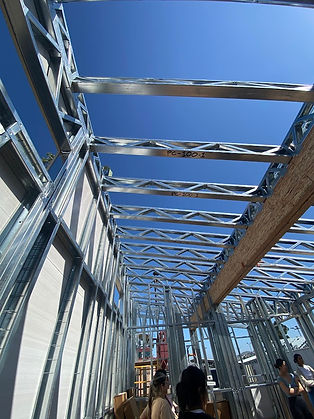
Pelagic’s steel framing components can be manufactured to precise dimensions, clearly labeled, and organized in the order needed for installation. Unlike conventional wood framing, installers are not required to measure, select, straighten, cut, and individually fabricate every framing member at the jobsite.
The lightweight components are assembled primarily with mechanical fasteners. Onsite welding is normally unnecessary, and traditional carpentry techniques such as extensive cutting, notching, planing, and correcting warped material are greatly reduced. This allows much of the frame installation to be completed by a smaller, properly trained assembly crew rather than relying entirely on a large crew of costly, highly skilled carpenters. (BuildSteel.org)
Steel framing installation is not unskilled work. Crews must be trained to read the installation plans and correctly follow the specified fastener schedules, bracing, connections, load paths, and safety requirements. However, the repeatable assembly process is generally easier to teach and standardize than traditional onsite framing fabrication.
Less Time Framing Means Less Money Spent on Labor
With conventional wood construction, a significant portion of labor is spent:
-
Measuring and cutting individual framing members
-
Sorting and selecting usable lumber
-
Correcting twisted, crowned, bowed, or damaged material
-
Constructing walls piece by piece at the jobsite
-
Managing offcuts and material waste
-
Making adjustments where framing does not match the plans
Panelized steel framing moves much of this work into the manufacturing process. Walls and other framing components can arrive ready to assemble, reducing onsite fabrication and allowing the structure to be framed with fewer workers over fewer working days.
Prefabricated cold-formed steel systems have demonstrated substantially shorter installation periods on certain projects. The exact savings depend on the home’s size, design, access, engineering, crew experience, and level of prefabrication, but faster framing can materially reduce total labor expense. (BuildSteel.org)
Faster Framing Can Reduce Costs Beyond the Framing Crew
A shorter frame-up period can also create savings throughout the project by allowing the building to become enclosed sooner and enabling follow-on trades to begin earlier.
Potential benefits include:
-
Fewer total framing labor hours
-
Smaller installation crews
-
Reduced equipment-rental periods
-
Lower supervision and jobsite overhead
-
Less exposure to weather delays
-
Earlier access for plumbing, electrical, HVAC, and other trades
-
A shorter overall construction schedule
-
Reduced financing and carrying costs
-
Earlier completion, occupancy, or sale
For builders and developers, schedule certainty can be almost as important as the direct material price.
.